
Spray Booth for Radiator Painting &
Condenser Paint Booth – Autocoat Engineering
Autocoat Engineering has vast experience in the field of pretreatment for radiator and condenser painting — designing specialised paint booths for radiators of all sizes, with conveyorised painting lines, IR drying ovens and material handling systems. Exported to Sharjah, Saudi Arabia and beyond. India’s leading radiator spray booth manufacturer since 1985, based in Thane, Maharashtra.
About Radiators, Condensers & Radiator Painting
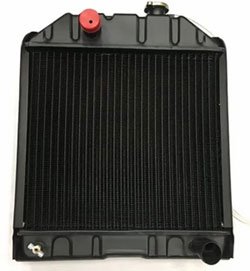
The radiator is one of the most important heat exchanging components in a motorbike or car. In a car, both a radiator and condenser coil are present. The condenser is a larger heat exchanger installed in front of the vehicle, typically beside or right in front of the radiator. The ambient air is pushed through the condenser fins by an electric fan and by natural flow during driving.
Car radiator and car condenser may look similar, but they serve very different purposes. A radiator cools the engine by circulating coolant through its fins, while a condenser helps to keep the interior of the car cool by circulating refrigerant.
Autocoat Engineering has vast experience in the field of pretreatment for radiator painting. Pretreatment of radiators or condensers is a little different from regular sheet metal products — the choice of material decides the type of pretreatment to be used. Paints and powder coating play an important role in the aesthetics and durability of a condenser or radiator.
Surfaces That Do Not Require Coating
Any painting process begins with surface preparation. The choice of paint or powder should be adaptive to copper fins and MS tank body at the same time. The following surfaces will not require protective coating — masking is applied to these areas:
If it is an aluminium radiator, most of these go through a powder coating process rather than liquid painting. Powder coating for radiators is done mostly when the radiators are to be exported to other countries — powder coating has good resistance for sea travel and humid areas. This process works best with smaller size radiators. Both condensers and radiators are also powder coated by various companies depending on the surface requirement.
Radiator Painting Process – 3 Stages
Autocoat’s complete radiator painting process covers three distinct stages — from pretreatment and water removal through to final coat painting and drying:
Pre-Treatment of Radiator Body & Water Removal
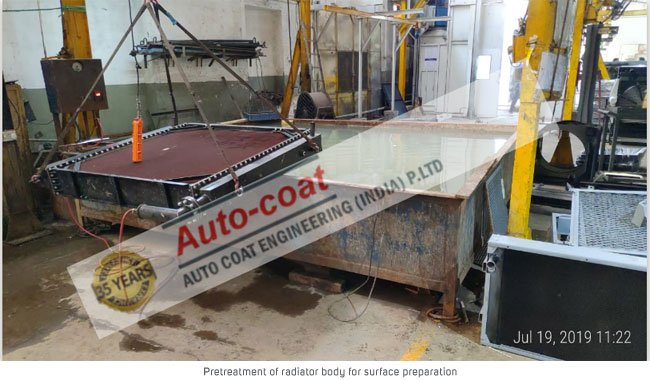
Cleaning of the surface of the radiator tank is carried out after assembly is checked. The pre-treatment of radiators happens during leak testing — two or maximum three tanks are sufficient for the leak testing of the tanks of a radiator. For aluminium radiators, after the leak test most are sent to the powder coating line.
It is also necessary to remove the water content trapped between the radiator or condenser fins. This percolated water can cause blisters, or the water turns to steam when exposed to oven heat — giving a very odd surface with holes in the paint film. Therefore it is essential to remove the trapped water from the fins by the air washing method before painting.
Painting in Radiator / Condenser Spray Booth — Single Final Coat
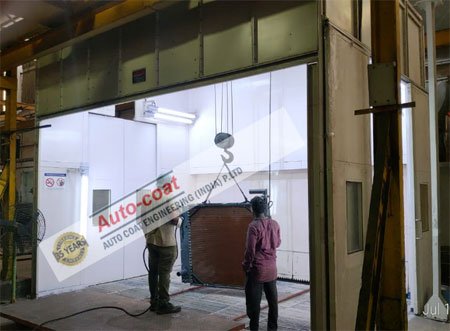
Once the radiator or condenser is totally free from water from the previous process, these radiators are painted with a directly applied single final coat. Most of the time it is a heat-resistant paint with high gloss. In the case of condensers, they are painted in the condenser spray booth with a similar single coat. Condensers often have a lighter shade and are mostly built in aluminium construction.
The paint coat applied over the radiator must withstand high temperatures on the external surface while it is running, and must also aesthetically look better. For high productivity, radiators are placed on jigs so that multiple radiators or condensers can be painted in the condenser paint booth. With heavy-duty jigs and good spray guns, the desired paint film in microns is achieved — the paint booth removes undesired overspray from the painting area, giving even smooth coating.
A small conveyorised spray booth for radiators can give a production output of 40 to 100 units per day on an 8-hour shift basis.
Drying of Liquid Painted Radiators — IR Lamp Method
The combination of mild steel tank, copper fins and black paint is perfectly suitable for absorbing a good amount of heat from the oven. Radiators can be dried by convection type heating or radiation type heating. Convection type heating takes a lot of space for the heat exchanger and other accessories.
Autocoat has developed a faster method of drying for radiators — the painted radiators are heated by means of infrared (IR) lamps or IR lights. The radiation from these IR lamps instantly raises the temperature of the black body, allowing the thinner content to evaporate in a quick interval — making the process faster and more space-efficient than conventional convection ovens.
Conveyorised Painting & Material Handling for Large Radiators
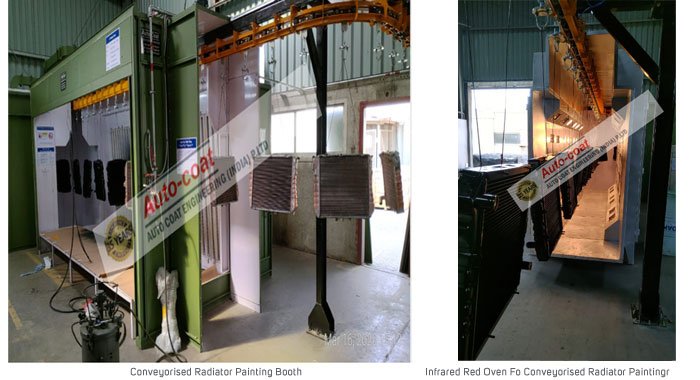
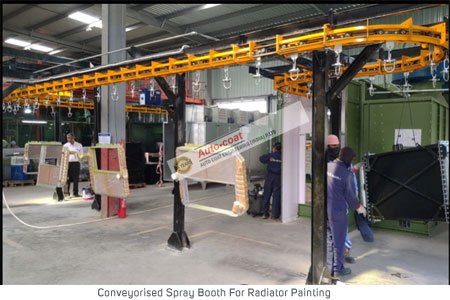
Autocoat has supplied many radiator paint booths and conveyorised radiator painting lines, running almost on a 3-shift basis trouble-free. Autocoat has designed, developed and manufactured conveyor radiator painting lines with conveyors for pre-heating and post-heating of radiators, handling multiple weights in the same equipment. Conveyorised radiator and condenser painting is very fast and economical.
Autocoat has also developed specialised material handling paint booths for large condensers and radiators. Most radiator companies paint large radiators horizontally on the floor — after painting one side, the component is left for air drying for 8 to 12 hours, then the other side is turned for painting. This is a very primitive way of painting that can cause dust and dirt settling on wet paint and variation in colour shade as they are painted at different timings.
With a paint booth for radiators with material handling equipment, both sides of the radiators can be painted at the same time without hassles — the same technique is used in conveyorised spray booths for radiators. All radiator paint booths have a dedicated material handling method that enhances the capability of the painter to lift and lower the heavy radiator and also to rotate it.
Conveyorised vs Batch – Radiator Painting Methods
Autocoat supplies radiator painting solutions for both high-volume conveyorised production and large radiator batch painting with material handling:
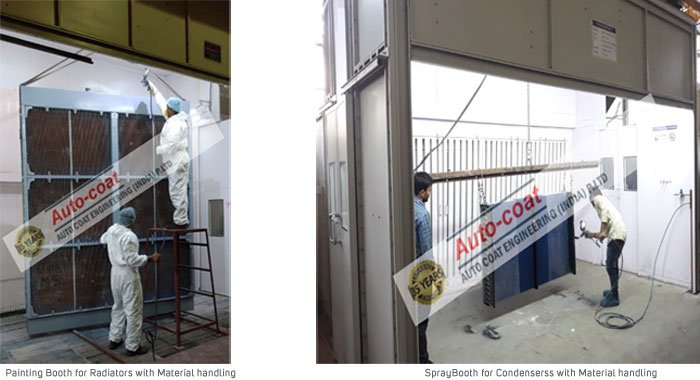
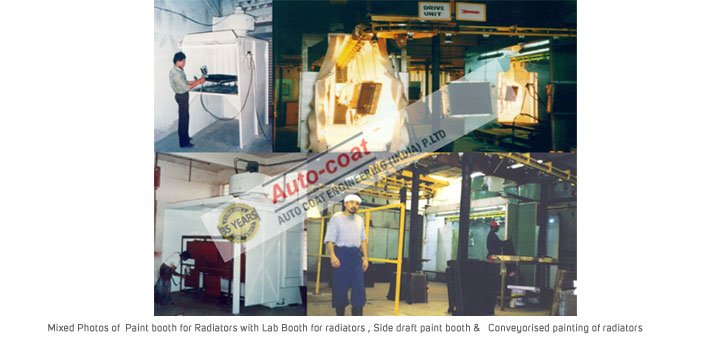
Conveyorised vs Batch Painting – Comparison
| Feature | Conveyorised Radiator Painting | Batch / Material Handling Booth |
|---|---|---|
| Best For | Small to medium radiators & condensers | Large & heavy radiators |
| Production Output | 40–100 units / 8-hr shift | Flexible — per component |
| Production Shifts | 3-shift basis — trouble free | Batch basis |
| Both Sides Painted Together | Yes — simultaneous | Yes — with material handling |
| Drying Method | IR lamp — fast & space saving | Air dry or IR oven |
| Pre-heat & Post-heat Conveyor | Yes — multi-weight support | Not applicable |
| Risk of Dust on Wet Paint | Minimal — enclosed process | Minimal — enclosed booth |
| Colour Variation Risk | None — same-time painting | None — same-time both sides |
| Pollution Compliance | Yes | Yes |
Radiator Spray Booth – Key Features
Specialised Pretreatment Process
Pretreatment of radiators and condensers is different from regular sheet metal — Autocoat applies 2–3 tank leak testing process, with the choice of pretreatment decided by the material (copper fins, MS tank, aluminium body).
Air Washing — Fin Water Removal
Trapped water between radiator or condenser fins is removed by the air washing method before painting — preventing blisters and holes in the paint film that would otherwise appear when heat is applied during drying.
Single Coat — Heat Resistant High Gloss Paint
Radiators and condensers are painted with a directly applied single final coat of heat-resistant, high-gloss paint — designed to withstand high external surface temperatures during engine operation.
Conveyorised Lines — 40 to 100 Units/Day
Autocoat’s conveyorised radiator painting lines run on a 3-shift basis trouble-free, with pre-heating and post-heating conveyors handling multiple weights in the same equipment — fast and economical for high-volume production.
IR Lamp Drying — Faster Than Convection
Autocoat’s developed IR lamp drying method instantly raises the temperature of the painted black body, allowing thinner to evaporate in a quick interval — far faster and more space-efficient than conventional convection ovens.
Pollution Board Norm Compliance
Autocoat radiator spray booths are very efficient and match pollution board norms — ensuring overspray is fully captured and the workshop environment remains safe and compliant for painters and subordinates.
Training sessions are conducted by Autocoat to educate painters and subordinates for maximum productivity and effective maintenance of radiator spray booths. Every booth is manufactured, assembled, numbered, tested and live trials are given at the customer’s facility. Detailed instruction manuals, SOP laminations and TPM activity guidance are included with every unit.
Spray Booth for Radiator Painting – Applications
Autocoat Spray Booths for Radiator Painting and Condenser Paint Booths serve the following applications: