
Alternator Paint Booth & Spray
Booth for Alternators – Autocoat Engineering
Autocoat Engineering has vast experience in manufacturing specialised Alternator Paint Booths and Spray Booths for Alternator Generators — covering all painting processes from pretreatment of casting bodies, gel coat insulation spraying on stators and rotors, to final finish coat on assembled alternators. Dedicated material handling jigs, roller conveyors, hoist facilities and conveyorised alternator painting lines — running trouble-free on 3-shift basis across India.
About Alternator Paint Booths
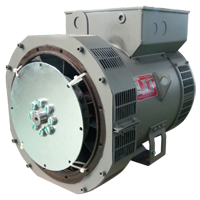
An alternator, as an integral part of every combustion engine vehicle, has the primary responsibility of converting chemical energy to electrical energy — charging and replenishing the battery and other electrical components in the vehicle. An alternator is also an electrical generator that converts mechanical energy to electrical energy in the form of alternating current.
Autocoat Engineering has a vast experience in the field of pretreatment of parts of electric motors and induction motors before painting. Most important is the process flow — which divides the pretreatment process as per material of construction. Alternator and generator castings are pretreated separately, while some parts are pre-cleaned in the paint booth before final painting. The painting line for alternators should not only take care of the aesthetics but also the internal parts such as stator and rotor.
Alternator Painting – Three Main Parts
Alternators, like motors, are divided into 3 major parts — each requiring its own painting process:
Alternator Painting – 4 Processes in the Spray Booth
The complete alternator painting sequence in the Autocoat spray booth for alternators covers the following four processes:
Pretreatment of Alternator Casting Body
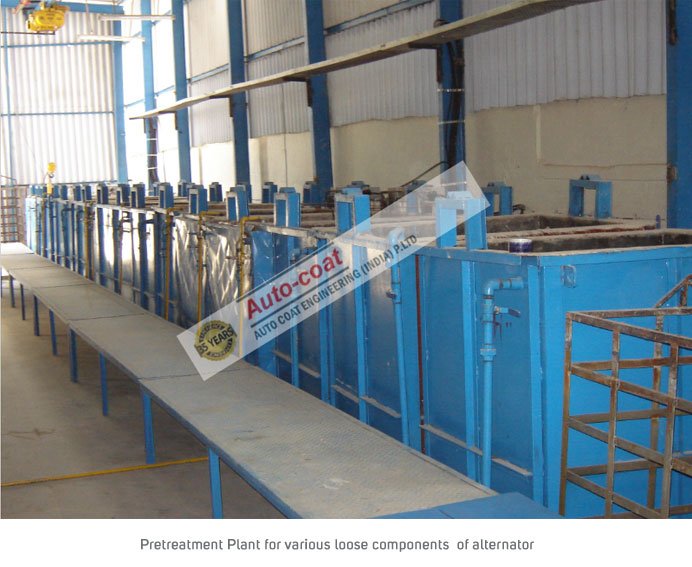
Castings after manufacture take a lot of time to reach the final customer before being sent to the alternator paint booth. Therefore Autocoat recommends shot blasting such alternator castings at the vendor’s premises — followed by a coat of primer paint or red oxide applied in the alternator spray booth at the vendor’s site.
An alternative method of pretreating alternator castings and fabricated items is by having a dedicated 9-tank pretreatment process with water drying tank equipment. This process also provides a phosphating coating to the various parts — increasing paint adhesion properties. Pretreatment of alternator castings removes rust and oil contamination accumulated during previous manufacturing processes. Pretreatment plants are also widely known as Phosphating Plants.
Gel Coat Insulation Spraying on Stator
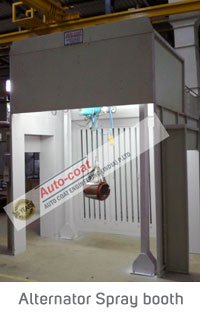
Once the stator is assembled with internal copper windings and other accessories, it is sprayed with gel coat insulation. This gel coat is also known as epoxy resin or varnish. Normally such resins are applied by brush or dip/rolling process — but now with the use of special spray guns, the gel coat can be sprayed in the alternator spray booth. The special spray guns are able to handle the high viscosity of the thick gel resin.
Autocoat has devised many such spray booths for alternators where gel coats are sprayed and all overspray is captured on a continuous basis. Spraying the gel coat gives even coverage on all required insulated parts of the stator.
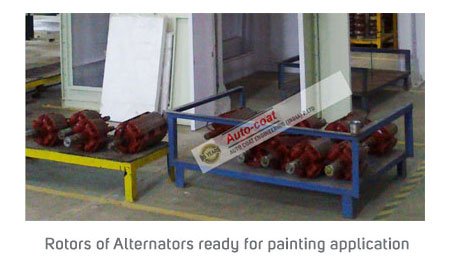
Gel Coat Varnish on Rotor
In this process, the gel coat varnish spraying on the rotor is carried out in the rotor painting spray booth — following the same method as the stator. Rotor gel spraying is faster than the stator process as the component size is approximately 50% of the stator.
With better jigging, 2 rotors at a time can be painted for better production economics. Autocoat has supplied many such gel coat booths for alternator internal parts painting.
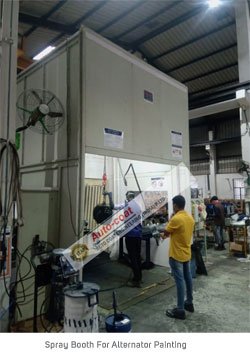
Final Finish Coat on Assembled Alternator
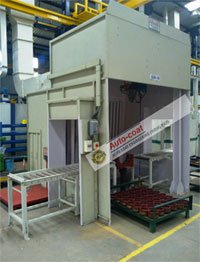
After a series of tests, assembled alternators or generators are lifted with handling cranes or other mechanisms and loaded into the paint booth or onto the conveyor. Assembled alternator generators are heavy and large in size — Autocoat has devised special mechanisms and jigs to accommodate weight-wise heavy alternators and generators with minimised manual effort.
Material movement of semi-large, heavy alternators is done by roller conveyors with hoist facility. Autocoat’s paint booth for alternators has very good suction to capture any paint dust floating in the air and trap it inside the extraction chamber.
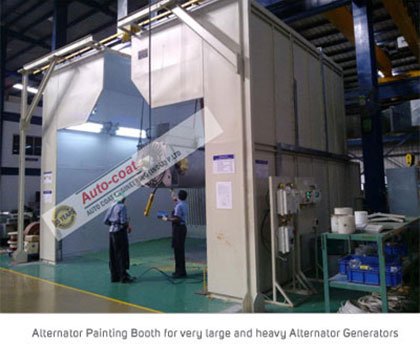
Very Large Alternators & Generators in the Paint Booth
Special heavy generator alternators — used in windmill generators and power plants — tend to have complex size, shape and can weigh more than 4 to 5 tonnes. Such alternators can only be handled with factory EOT hoists. Due to this kind of handling requirement, Autocoat provides a large top slot on the alternator spray booth — enabling easy movement of generators inside the paint booth for shifting, lifting and lowering activities.
All Autocoat alternator paint booth photos show dedicated material handling methods that enhance the painter’s capability to lift and lower heavy alternators, and to rotate them for all-sided painting. Autocoat spray booths are very efficient and match all pollution board norms. Training sessions are conducted to educate painters and subordinates to achieve maximum productivity and effective maintenance.
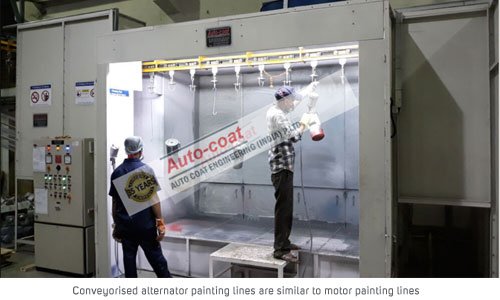
Autocoat has supplied many alternator paint booths and conveyorised motor painting lines which are running on a 3-shift basis trouble-free. Autocoat has designed, developed and manufactured conveyorised alternator painting lines — similar to motor painting lines. For small size alternator painting, the conveyorised setup is very fast and economical. With the addition of an online convection oven, the drying process of the paint film can be accelerated and dust settling on painted alternators can be greatly reduced.
Autocoat Alternator Paint Booth – Key Features
Autocoat’s Alternator Paint Booths are designed with the following specialist features:
- High-Suction Extraction SystemVery good suction to capture all paint dust floating in the air and trap it inside the extraction chamber — meeting pollution board norms efficiently.
- Large Top Slot for EOT CraneLarge top slot provided on the alternator spray booth for easy movement of heavy generators inside the booth — lifting, shifting and lowering by factory EOT hoist.
- Special Jigs for Heavy AlternatorsWeight-wise heavy alternators and generators accommodated with special jigs — minimising manual effort for loading, rotating and unloading during painting.
- Roller Conveyor + Hoist HandlingMaterial movement of semi-large, heavy alternators done by roller conveyors combined with hoist facility — for smooth, safe and efficient material flow through the painting line.
- Gel Coat Spray CapabilitySpecially designed booths handle high-viscosity gel coat (epoxy resin/varnish) through special spray guns — with continuous overspray capture for stator and rotor insulation coating.
- Conveyorised Painting LinesFully conveyorised alternator painting lines available — with online convection oven for accelerated paint drying and reduced dust settling. Running on 3-shift basis trouble-free.
Compliance & Key Benefits
Operator Safety
High-suction exhaust system continuously removes paint fumes, gel coat vapours and overspray from the painter’s breathing zone throughout all alternator painting processes.
Pollution Board Compliant
Autocoat alternator spray booths are designed to meet all pollution board norms — overspray is trapped in the extraction chamber and does not escape to atmosphere.
Aesthetic & Functional Finish
The alternator painting line takes care of both aesthetics (external casing finish) and functional requirements (even gel coat insulation on stator and rotor for electrical performance).
Training & Productivity
Training sessions are conducted to educate painters and subordinates on maximum productivity and effective maintenance — ensuring trouble-free operation across all shifts.
Alternator Paint Booth Applications
Autocoat Alternator Paint Booths and Spray Booths for Generators are suitable for the following applications: