
Downdraft Booth & Downdraft
Paint Booth – Autocoat Engineering
Autocoat Engineering manufactures Dry & Wet Downdraft Paint Booths specially designed for heavy parts and large components — wagons, earth-moving machinery, chassis, trailers, buses and locomotives. Vertical top-to-bottom airflow ensures OSHA compliance, fire safety and superior paint finish quality. India’s most experienced Downdraft Booth manufacturer since 1985, based in Thane, Maharashtra.
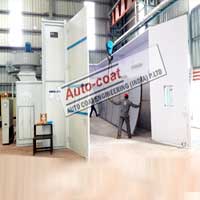
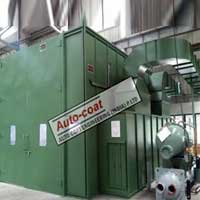
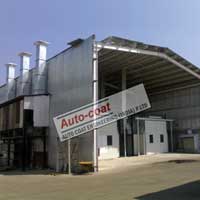
About Downdraft Booths
Autocoat Downdraft Booths are specially used for painting of heavy parts and large components which are difficult to handle — namely wagons, earth-moving machinery, chassis of vehicles, trailers, buses, locomotives and cranes. In a Downdraft Booth, air flows from top to bottom, with the air draft directed towards the ground or into the exhaust chamber below, carrying overspray paint particles away from the painter’s breathing zone at all times.
The Wet Downdraft Booth can be single-sided or double-sided extraction chamber depending on the size of the component. The painter goes around the component to paint all sides. Overspray paint particles are exhausted downward through floor grating and then into a water tank — where turbulent action causes the paint particles to form a paint sludge, and paint-free air is exhausted to blowers and finally to atmosphere. Water Wash Downdraft Paint Booth is popular in mass production where paint consumption is very high. Such booths require extensive civil work for the booth as well as for the paint sludge removal system, and are therefore more expensive.
When paint consumption is low, a Dry Downdraft Paint Booth can be considered. In a Dry Back Downdraft Booth, paint overspray is directed through metal baffles and replaceable filters as per Autocoat’s 4-level filtration system, exhausting paint-free air to atmosphere to fulfil pollution norms. Autocoat’s improved 4-level filtration system reduces recurring filter replacement cost to amazingly low levels compared with competition.
Autocoat Downdraft Booth – Key Features
Autocoat’s Downdraft Paint Booths incorporate the following proven design features:
- Vertical Top-to-Bottom AirflowAir draft moves from ceiling to floor, carrying all overspray particles downward away from the painter’s breathing zone.
- Large & Heavy Component PaintingDesigned for wagons, earth-moving machinery, chassis, trailers, buses, cranes and locomotives.
- Wet Downdraft — Water Sludge SystemOverspray passes through floor grating into a water tank; turbulent action forms paint sludge; paint-free air exhausted to atmosphere.
- Dry Downdraft — 4-Level FiltrationAutocoat’s improved 4-level metal baffle and filter system captures overspray with amazingly low filter replacement cost.
- Single or Double-Sided ExtractionWet Downdraft Booths available in single-sided or double-sided extraction chamber configuration based on component size.
- Air Supply Unit CompatibleDowndraft Spray Booths can be connected in-line with air supply units or air replacement units for enhanced performance.
Dry Downdraft vs Wet Downdraft – Which to Choose?
Autocoat’s engineers guide you in selecting the right Downdraft Booth type based on paint consumption and component size:
- Ideal for low paint consumption applications
- Autocoat 4-level metal baffle filtration
- Amazingly low filter replacement cost
- No water tank or ETP system required
- Lower civil work and installation cost
- Meets pollution norms efficiently
- Easier maintenance — clean baffles & filters
- Ideal for high paint consumption / mass production
- Water wash system removes overspray via grating
- Single or double-sided extraction chamber
- Paint sludge collected in water tank below floor
- Requires extensive civil & concrete work
- Pit-type design needs excavation
- Higher capital cost — suited to large-volume OEMs
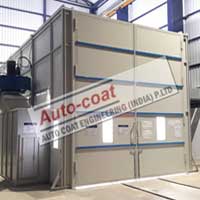
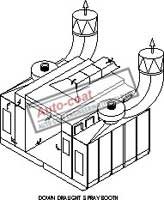
Large Downdraft Painting Booths are designed for hand spray of the largest types of work — earth-moving equipment, tractors, locomotives, buses and cranes. Depending on the nature of work, Large Downdraft Spray Booths may be single-sided or double-sided, and open, partly enclosed or fully enclosed. Airflow is vertical from top to bottom through either an open roof or through an air replacement system. Open type Large Dry Downdraft Paint Booth is the most popular and cost-effective choice for all industrial products.
Compliance & Safety Standards
A correctly designed and installed Autocoat Downdraft Spray Booth fulfils all of the following:
Operator Safety
Vertical downward airflow continuously moves solvent fumes and paint overspray away from the painter’s breathing zone, meeting OSHA safety requirements.
Fire Safety
Efficient downward exhaust of flammable solvent vapours eliminates fire risk in and around the spray painting area for all component sizes.
Pollution Norms
Autocoat’s 4-level filtration (Dry type) or water wash system (Wet type) meets Particulate Matter pollution norms as per Indian regulatory requirements.
Paint Finish Quality
Controlled vertical airflow in the painting enclosure ensures a high-quality, dust-free finish with no overspray contamination on wet painted surfaces.
Downdraft Booth Types – Comparison
| Feature | Dry Downdraft Booth | Wet Downdraft Booth |
|---|---|---|
| Airflow Direction | Vertical — top to bottom | Vertical — top to bottom |
| Overspray Capture | 4-Level metal baffles & filters | Water tank via floor grating |
| Paint Consumption | Low paint consumption | High paint consumption / mass production |
| Filter / Running Cost | Amazingly Low (Autocoat 4-level) | Water & sludge management cost |
| Civil Work Required | Minimal | Extensive — pit excavation & concrete |
| ETP / Water System | Not required | Required — water tank & sludge removal |
| Extraction Chamber | Below floor / exhaust duct | Single or double-sided water chamber |
| Air Supply Unit | Compatible | Compatible |
| Capital Cost | Lower | Higher |
| Best For | Industrial, low-volume, large parts | Automotive, mass production OEMs |
Downdraft Booth Applications
Autocoat Downdraft Paint Booths are the preferred choice for large, heavy and difficult-to-handle components across Indian industry: